Moving an Aging Parent From Out of Town: How to Manage the Move Remotely
Moving an aging parent from out of town can feel overwhelming before the move even begins.
When you live several hours—or several states—away, you may suddenly find yourself trying to manage your own work and family while also coordinating your parent’s belongings, movers, deadlines, paperwork, old home and new home from a phone.
You may be the person everyone calls when a decision needs to be made.
But that does not mean you have to personally manage every detail.
The key is knowing which parts of the transition truly require you—and which simply require someone you trust.
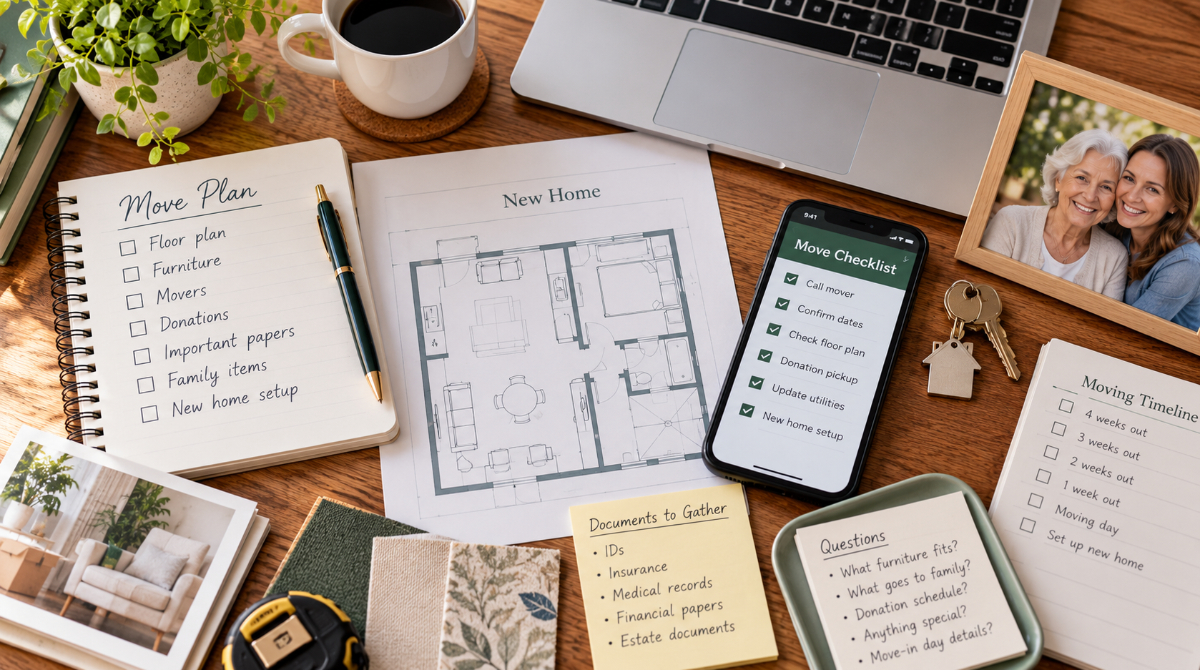
Start by Separating Family Decisions From Move Tasks
Some decisions genuinely need family involvement:
- important documents and financial papers
- sentimental belongings and heirlooms
- items being passed to family members
- major furniture decisions
- questions about the new residence
Other tasks simply need to get done:
- measuring furniture
- arranging donations
- coordinating movers
- preparing for packing
- unpacking
- setting up the new home
When you are managing a parent’s move remotely, ask:
“Does this require me—or does it require someone capable and trustworthy?”
That question can save an enormous amount of time and stress.
Keep Your Parent or Parents Involved
Distance can make decisions happen quickly by phone, email and text.
That can leave an older adult feeling as though everyone else is managing their life.
Whenever possible, keep your parent or parents part of the process.
Ask which belongings matter most.
Ask what they want the new home to feel like.
Ask what they are worried about.
Ask which familiar items they want nearby right away.
The goal is not to remove them from the process.
It is to remove some of the burden surrounding the process.
Create One Place for Important Information
Remote move management gets harder when information lives in six different places.
One sibling has a text thread. The mover sent an email. The senior living community left a voicemail. Someone wrote furniture measurements on a scrap of paper.
Create one central place for the details.
Include:
- move-in date
- floor plan
- important contacts
- furniture measurements
- donation plans
- family decisions
- items going to relatives
- unanswered questions
It does not need to be sophisticated.
It just needs to be clear.
Protect Important Papers and Sentimental Belongings Early
When someone has lived in a home for decades, important things are rarely stored in one obvious place.
Legal documents may be tucked into a desk. Jewelry may be in several rooms. Family photographs may be mixed with ordinary papers.
Identify these items early and set them aside clearly.
Make sure anyone working in the home knows they require special handling.
When you are coordinating from a distance, you should not have to wonder whether something meaningful disappeared because the project moved too quickly.
Plan the New Home Before Moving Day
A successful move is not simply getting everything out of one house and into another.
The new home has to work.
Think through:
- what furniture will fit
- what your parent uses every day
- what should be easy to reach
- where important papers belong
- how the kitchen should function
- which familiar belongings should be visible immediately
The more decisions made ahead of time, the less stressful moving day becomes.
And instead of arriving to a room full of boxes, your parent or parents can begin settling into a space that already feels familiar.
Know When Moving an Aging Parent Remotely Has Become Too Much
Sometimes a family can handle most of the transition themselves.
Sometimes distance, deadlines and too many moving pieces make that unrealistic.
You may already be working with a mover, realtor, senior living community, donation organization, auction company and family members.
Individually, each piece may seem manageable.
Together, they can become a second job.
That is often the point when families realize they do not need another vendor to manage.
They need someone local who can help connect the pieces.
A trusted transition partner can help coordinate practical details, keep the project moving, communicate when decisions are needed and keep your parent or parents involved.
For families managing a senior move from outside Hampton Roads, that can mean fewer emergency trips—and far less of the move living in your head every day.
At Ideal Organizing + Design, Lead Organizer Michael Gettier is a Certified Senior Move Manager through NASMM, the National Association of Senior & Specialty Move Managers.
You Can Be Present Without Being Physically There
Helping a parent through a move is not measured by how many boxes you personally pack.
You may be the person making important family decisions.
The person they call when they are worried.
The person keeping siblings informed.
The person protecting what matters most.
And the person making sure the right support is in place when you cannot be there yourself.
If your parent or parents are moving in Hampton Roads while you are trying to manage the transition from somewhere else, you do not have to carry every part of it alone.
Sometimes the best way to help is not to do everything yourself.
It is to make sure the right people are beside them.